
Key Takeaways
- Native trees evolved within Florida ecosystems and can support local food webs, but "native" does not mean a tree will thrive anywhere in Sarasota.
- The best species depends on whether the site is dry or wet, inland or salt-exposed, open or constrained.
- Plan for mature canopy size and nearby structures.
- Use a mix of species and canopy layers to create more useful habitat.
- Native trees still need proper planting, watering and pruning while they establish.
- Avoid planting a large tree where repeated clearance pruning will be unavoidable.
- For site-specific selection and installation, visit our tree planting and installation service.
Direct answer: Strong native-tree choices for Sarasota can include live oak, southern magnolia, cabbage palm, slash pine, red maple, sweetbay magnolia and bald cypress. The best choice depends on whether the site is dry or wet, inland or salt-exposed, open or constrained.
Why Choose Native Trees for Sarasota Wildlife?
Florida native plants developed within regional ecosystems and can support local food webs. Trees may provide:
- Flowers and nectar for pollinators
- Leaves that serve as food for native insects
- Insects that become food for birds
- Fruit, seeds or nuts for birds and mammals
- Branch structure and cavities for nesting or shelter
- Shade and cover near water
A wildlife-friendly property usually includes more than one tree. Diversity matters. UF/IFAS Sarasota County notes that plant and habitat diversity can help address habitat fragmentation and support migrating birds and native pollinators.
Native does not mean a tree will thrive anywhere in Florida. Sarasota properties can vary from dry, sandy and salt-exposed sites to seasonally wet inland yards. Choose for the exact conditions.
Which Native Trees Are Good Choices for Sarasota Properties?
The following list is a starting point, not a substitute for evaluating the site.
| Native tree | Site fit | Wildlife value | Important planning note |
|---|---|---|---|
| Live oak (Quercus virginiana) | Full sun, room for a broad canopy, generally adaptable once established | Acorns, cover and insect habitat that supports birds | Large mature spread requires generous clearance from structures and utilities |
| Southern magnolia (Magnolia grandiflora) | Sun to partial shade, adequately drained soil | Seeds, flowers and dense evergreen cover | Large species; falling leaves and seed structures require landscape planning |
| Cabbage palm (Sabal palmetto) | Adaptable Florida sites, including some coastal exposure | Flowers and fruit used by wildlife | Protect the growing point and avoid severe overpruning |
| Slash pine (Pinus elliottii) | Open, sunny sites with enough vertical and root space | Seeds, bark and canopy habitat | Not suitable for every residential lot; damaged tops and nearby targets require careful risk planning |
| Red maple (Acer rubrum) | Moist or seasonally wet areas | Early flowers, seeds and canopy habitat | Select for moisture conditions; not the best fit for a chronically dry site |
| Sweetbay magnolia (Magnolia virginiana) | Moist soils, sun to partial shade | Flowers, seeds and cover | A useful choice for lower or wetter parts of a property |
| Bald cypress (Taxodium distichum) | Wet or periodically saturated sites, also adaptable after establishment | Seeds, canopy and habitat near water | Allow for mature size and site-specific root behavior |
Other native species may fit a particular Sarasota property. A professional should consider the exact location, desired mature size and exposure before recommending a final list.
Is Live Oak the Best Wildlife Tree for Every Yard?
No. Live oak is an important Florida native with substantial habitat value, but it becomes a large, wide-canopied tree. It needs space to develop without repeated conflict with roofs, pool cages, roadways or overhead lines.
A young live oak planted too close to a structure can create decades of corrective pruning and root-zone conflict. In an open site with adequate soil and mature clearance, it can become a long-lived landscape asset.
The decision should account for:
- Distance from buildings and screened enclosures
- Overhead and underground utilities
- Mature canopy spread
- Soil volume and compaction
- Drainage
- Wind exposure
- The property's tolerance for leaves and acorns
For existing mature trees, our tree health care service can help evaluate condition and long-term management needs.
Which Native Trees Work in Wet Sarasota Yards?
Red maple, sweetbay magnolia and bald cypress can be candidates for moist or seasonally wet areas. That does not mean they should be planted into every drainage problem.
Observe the property after rain:
- How long does water remain?
- Is the area seasonally wet or constantly saturated?
- Has fill soil changed the natural grade?
- Is irrigation contributing to the problem?
- Is the site exposed to saltwater or brackish flooding?
Correct species selection can work with a site's natural moisture. It should not be used to hide a drainage failure that threatens structures or roots.
What About Small or Constrained Sites?
Not every Sarasota property can support a large canopy tree. A narrow side yard, a small lot or a site with overhead utilities may not be suitable for a live oak or slash pine.
For constrained sites, an arborist or knowledgeable landscape professional can help identify smaller native trees or large shrubs that provide flowers, fruit or shelter without requiring constant size reduction. The best recommendation will depend on available width, overhead clearance, sun and local exposure.
The UF/IFAS "Right Plant, Right Place" principle recommends knowing mature height and width before selecting a plant. This reduces future pruning and maintenance.
Pro Tip: Mark the expected mature canopy width on the ground before planting. If the circle overlaps the roof, pool cage or neighboring structure, choose a different location or a smaller species.
How Do You Build a Wildlife-Friendly Tree Plan?
Use more than one species
A diverse landscape provides different food and shelter and is less vulnerable to a single pest or disease.
Include more than one canopy layer
Large canopy trees, smaller understory trees and shrubs can create varied cover. Avoid overcrowding them. Each plant needs enough mature space, light and soil.
Protect existing healthy trees
The most valuable habitat tree may already be on the property. Protect trunks and roots during construction, grading and driveway work. Mature trees cannot be quickly replaced by new plantings.
Reduce broad pesticide use
Insects are part of the food web. Follow integrated pest management principles and treat a verified problem with the least disruptive effective approach.
Provide water safely
Water features should be maintained to avoid stagnant conditions and should not create constant saturation around trees that require drainage.
Keep some habitat where risk is low
Deadwood can have habitat value, but it must be managed in context. A dead limb over a patio is different from habitat wood in an unused, low-risk area. Safety and targets come first.
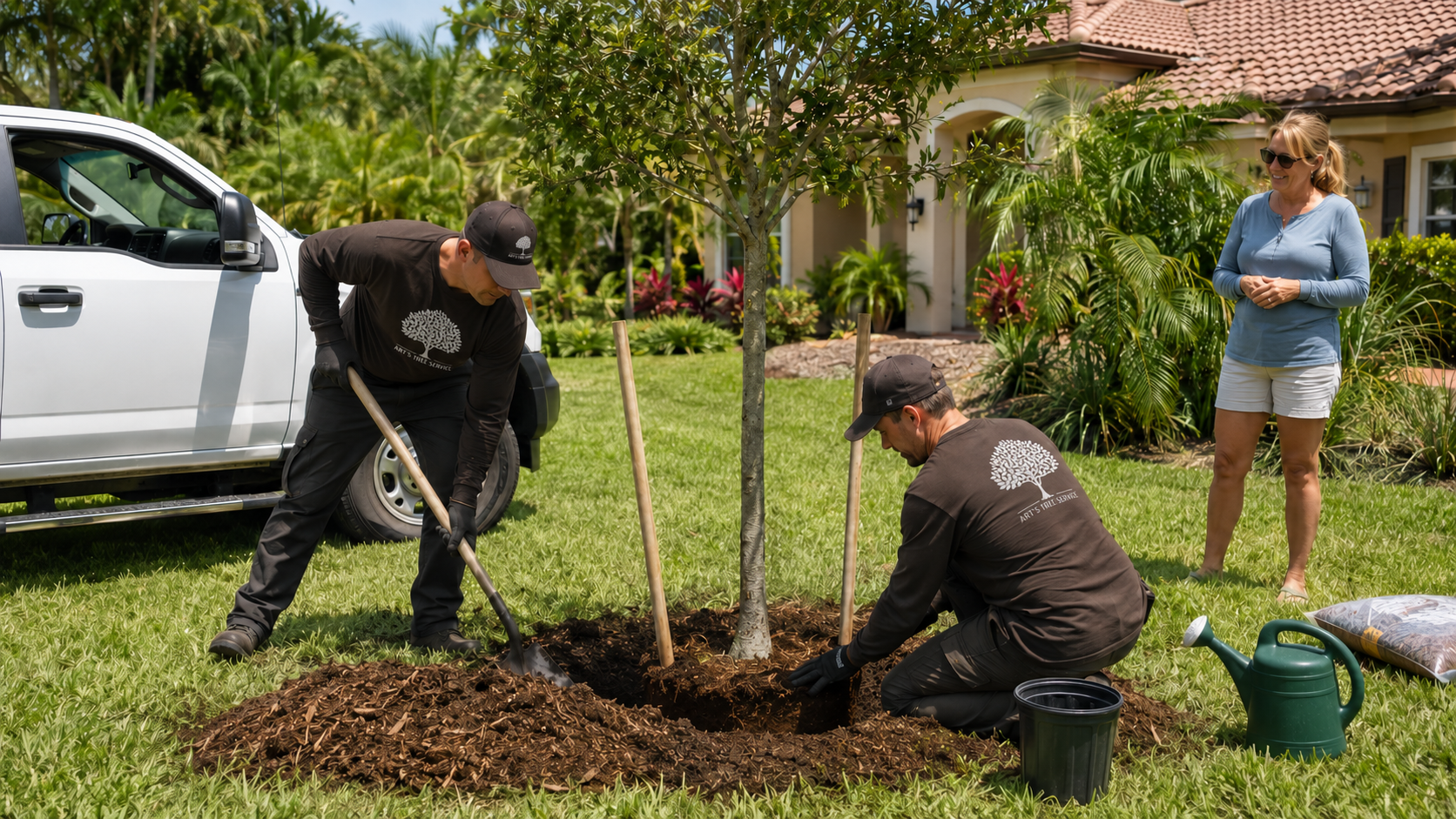
How Should a Native Tree Be Planted?
Correct installation strongly affects long-term health.
- Confirm the root flare and do not plant the trunk too deep.
- Dig a broad planting area and use the existing site soil for backfill unless a specific condition requires another approach.
- Keep mulch off the trunk.
- Water based on root-ball and soil conditions during establishment.
- Stake only when needed and remove or adjust staking before it damages the trunk.
- Keep turf equipment away from the trunk.
- Begin structural pruning while cuts are still small.
Art's Tree Service can help homeowners choose and install trees through our professional tree planting service.
Frequently Asked Questions
Are native trees always better than non-native trees?
Native trees often provide strong ecological benefits, but the best landscape choice must also fit the site. A well-suited, non-invasive non-native tree may perform better than a native tree planted in the wrong conditions.
Do native trees require no watering or fertilizer?
No. Newly installed native trees require establishment care, and even established trees can be stressed by drought, flooding, root damage or nutrient problems. Treat actual needs rather than assuming native means maintenance-free.
Which Sarasota native tree is best for birds?
There is no single best tree. Oaks support insects and produce acorns, magnolias provide seeds and cover, and palms and other fruiting natives can supply seasonal food. A diverse planting provides more consistent habitat.
Can I plant a large tree near my pool cage for shade?
Plan for mature canopy and root space, not current nursery size. A large tree too close to a pool cage can create clearance conflicts and increase damage potential. An on-site evaluation can identify a safer location or smaller species.
How far should a tree be planted from the house?
The distance depends on mature size, canopy form, roots, site conditions and the structure. Avoid a one-size-fits-all distance and select a location based on the specific species at maturity.