
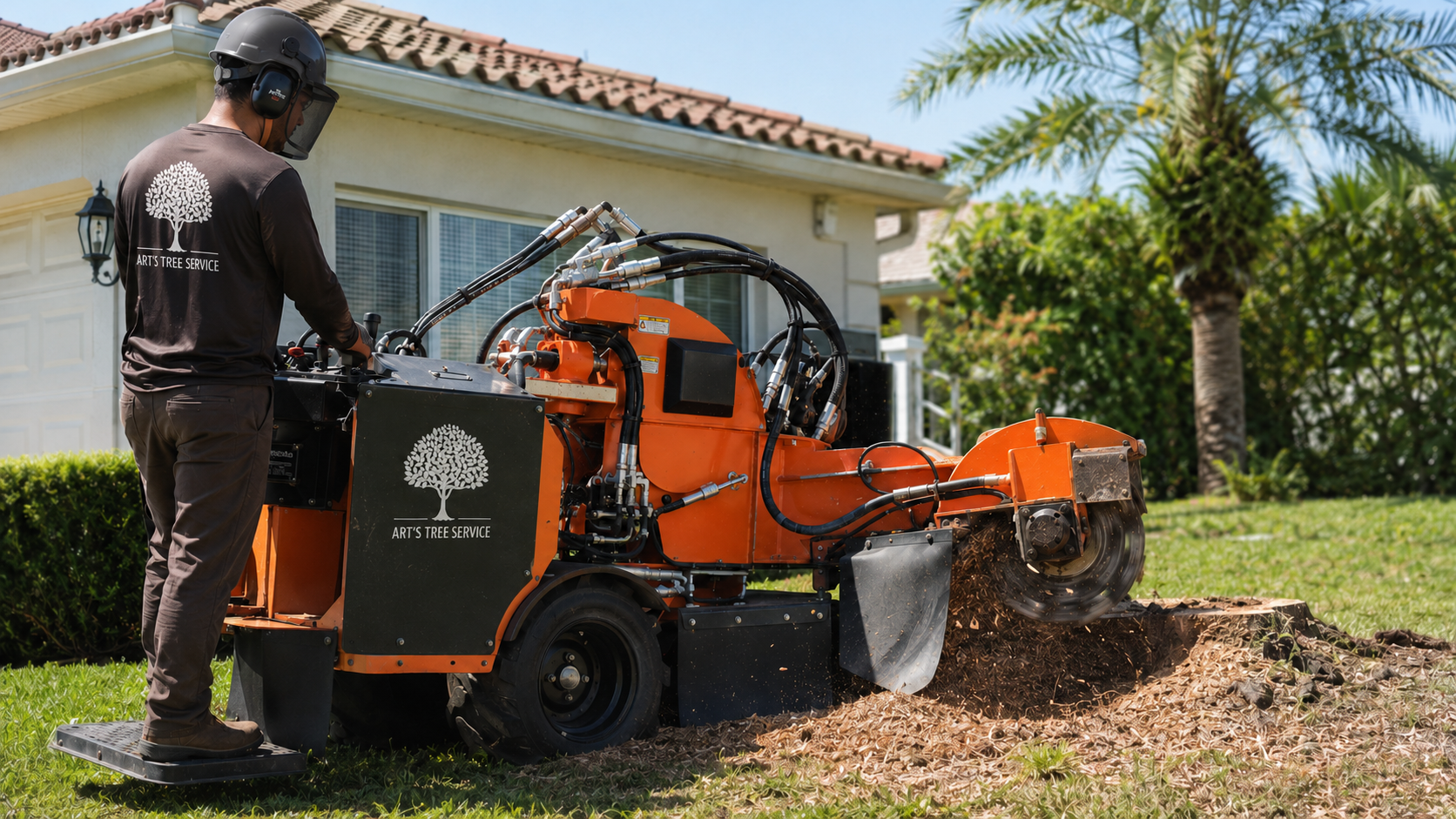
When comparing stump grinding vs. stump removal in Sarasota, grinding is usually the more practical way to eliminate the visible stump without excavating the entire root system. Full stump removal is more disruptive and is usually reserved for construction, excavation, hardscape installation or another project that requires the root mass to be removed.
The right choice depends on what you plan to do with the area, the stump's size and species, access for equipment, nearby utilities, roots and structures, and whether regrowth is likely.
Key Takeaways
- Stump grinding removes the visible stump below grade while leaving most roots in the soil.
- Full stump removal excavates the stump and a substantial portion of the root mass.
- Grinding is usually faster and less disruptive for a lawn or landscape bed.
- Removal may be necessary where future construction or excavation requires clear soil.
- Some species can produce sprouts after cutting or grinding and may need follow-up management.
- For an on-site recommendation, visit Art's stump grinding and removal service.
Direct answer: Choose stump grinding when you want to remove a trip hazard, improve appearance or reclaim a lawn or planting bed with limited disruption. Consider full removal when the exact area must be excavated for a foundation, pool, driveway, utility or structural replanting plan.
What Is Stump Grinding?
Stump grinding uses a machine with a cutting wheel to reduce the stump into wood chips. The operator grinds the main stump and, when included in the approved scope, visible surface roots in the work area.
Most of the underground root system remains in place. The roots gradually decay, and the ground may settle as organic material breaks down.
Grinding depth is not identical on every project. It depends on:
- The planned use of the area
- Stump diameter and root flare
- Equipment access
- Soil and grade
- Rocks, metal or foreign objects
- Irrigation and underground utilities
- Nearby pavement, fencing and structures
The estimate should state the intended depth, whether surface roots are included, how debris will be handled and whether backfilling or soil is part of the service.
What Is Full Stump Removal?
Full removal means excavating the stump and a substantial portion of the root mass. It can require heavier equipment, a larger work area and more restoration.
Even "full" removal may not capture every fine root extending through the yard. The practical objective is to remove enough stump and roots for the next use of the site.
Full removal may be considered when:
- A foundation, addition or pool will occupy the area
- A driveway, patio or structural hardscape needs clear subgrade
- Excavation is already planned
- A landscape plan requires deeper soil preparation
- The stump location conflicts with utilities or drainage work
- A specific species is repeatedly producing unwanted sprouts
Before excavation, underground utilities must be located and site access evaluated.
Stump Grinding vs. Stump Removal: Quick Comparison
| Factor | Stump grinding | Full stump removal |
|---|---|---|
| Main result | Visible stump reduced below grade | Stump and substantial root mass excavated |
| Root system | Most roots remain and decay | Major roots in excavation area are removed |
| Site disturbance | Usually lower | Usually higher |
| Equipment and access | Depends on grinder size and route | Often needs more working space |
| Typical residential use | Lawn, planting bed, appearance, trip-hazard reduction | Construction, excavation, hardscape or special site plan |
| Backfill needs | Grinding void and future settling may need soil | Larger excavation requires backfill and compaction planning |
| Cost | Usually lower, but site-specific | Usually higher, but site-specific |
What Happens to Roots After Stump Grinding?
Most roots remain underground and decay over time. The rate depends on species, root size, soil moisture, temperature and microorganisms.
As roots decay:
- Soil may settle in the stump area
- Small depressions can develop
- Mushrooms or other decomposers may appear
- Remaining roots may interfere with deep excavation
- Some species may produce sprouts
Mushrooms do not necessarily mean the original tree is still alive. They often reflect the decomposition of buried wood. However, any fungal growth should be identified if it is near a retained tree or if the original removal involved disease.
Do not assume grinding automatically eliminates every possibility of regrowth. Some woody plants can sprout from the stump or lateral roots. Species identification and follow-up treatment may be necessary.
When Should You Plant a New Tree After Stump Grinding?
Grinding debris and decaying roots can affect a new tree planted in the same spot. Consider:
- Is the grinding void filled with suitable soil?
- Are there enough roots remaining to interfere with the new tree's establishment?
- Was the original tree removed because of disease that could affect the replacement?
- Are utilities, structures or pool equipment nearby?
- Is there enough uncompacted soil for roots?
Our tree planting and installation team can help evaluate the replacement location.
Can You Leave a Tree Stump in the Yard?
You can leave a stump when it is in a low-use area and does not create a safety, maintenance or pest concern. It may even have habitat value in an appropriate setting.
Removal or grinding is usually preferable when the stump:
- Creates a trip hazard
- Interferes with mowing or landscaping
- Blocks a driveway, walkway or future project
- Produces unwanted sprouts
- Attracts attention to a recently removed tree
- Sits near an occupied area where decay creates a hole or unstable surface
The decision should reflect the actual use of the property, not appearance alone.
What Happens to the Wood Chips?
Grinding produces a mix of wood chips and soil. Depending on the project agreement, the material may be:
- Used to fill part of the grinding void
- Spread as mulch in an appropriate area
- Piled for the homeowner
- Hauled away
Fresh grinding debris is not a substitute for compacted structural fill. It decomposes and settles. If the area will become lawn, remove excess chips, add suitable soil and expect some follow-up leveling.
Keep mulch away from the trunks of retained trees and do not bury their root flares.
Pro Tip: Decide the final use of the space before requesting an estimate. The correct grinding depth and cleanup plan are different for sod, a flower bed, a patio and a new tree.
How Much Does Stump Grinding Cost in Sarasota?
There is no accurate flat price without seeing the site. Cost factors include:
- Stump diameter and height
- Species and wood density
- Number of stumps
- Surface roots
- Requested grinding depth
- Gate width and equipment access
- Slope and soil conditions
- Proximity to fencing, pavement or structures
- Rocks, embedded metal or previous fill
- Utility-location requirements
- Debris removal and backfill
Ask whether the estimate includes surface roots, cleanup, hauling and final grading. Comparing only the headline price can miss important differences in scope.
Should the Stump Be Ground at the Same Time as Tree Removal?
Often, yes. Coordinating the work can simplify access and leave the property ready for restoration. However, stump grinding and tree removal are separate scopes and should be listed clearly.
If the removal was related to disease, construction or a disputed property line, confirm the next step before grinding. Photographs or documentation may be needed first.
Learn more about Art's tree removal service and request a combined estimate when appropriate.
Frequently Asked Questions
How deep is a stump normally ground?
Depth varies with the machine, stump, roots and intended use of the area. The approved estimate should specify the planned result rather than relying on an assumed universal depth.
Will a tree grow back after stump grinding?
The original trunk will not grow back in the same form, but some species can sprout from remaining stump tissue or lateral roots. Follow-up treatment may be required.
Do stump roots damage foundations after grinding?
Roots generally do not continue expanding after the tree is dead, but existing roots and the soil changes created as they decay can affect a site. Foundation or structural concerns require evaluation by the appropriate qualified professional.
Can I put sod over a ground stump?
Yes, after excess wood chips are removed and suitable soil is added. Expect settling and plan to top up and level the area as buried material decomposes.
Does grinding remove surface roots?
Only if those roots are accessible, within the agreed work area and included in the scope. Confirm this before work begins.
Is stump grinding safe near irrigation or utilities?
The work area must be evaluated. Utility locating, irrigation marking and careful equipment planning may be required. Tell the estimator about all known underground systems.