
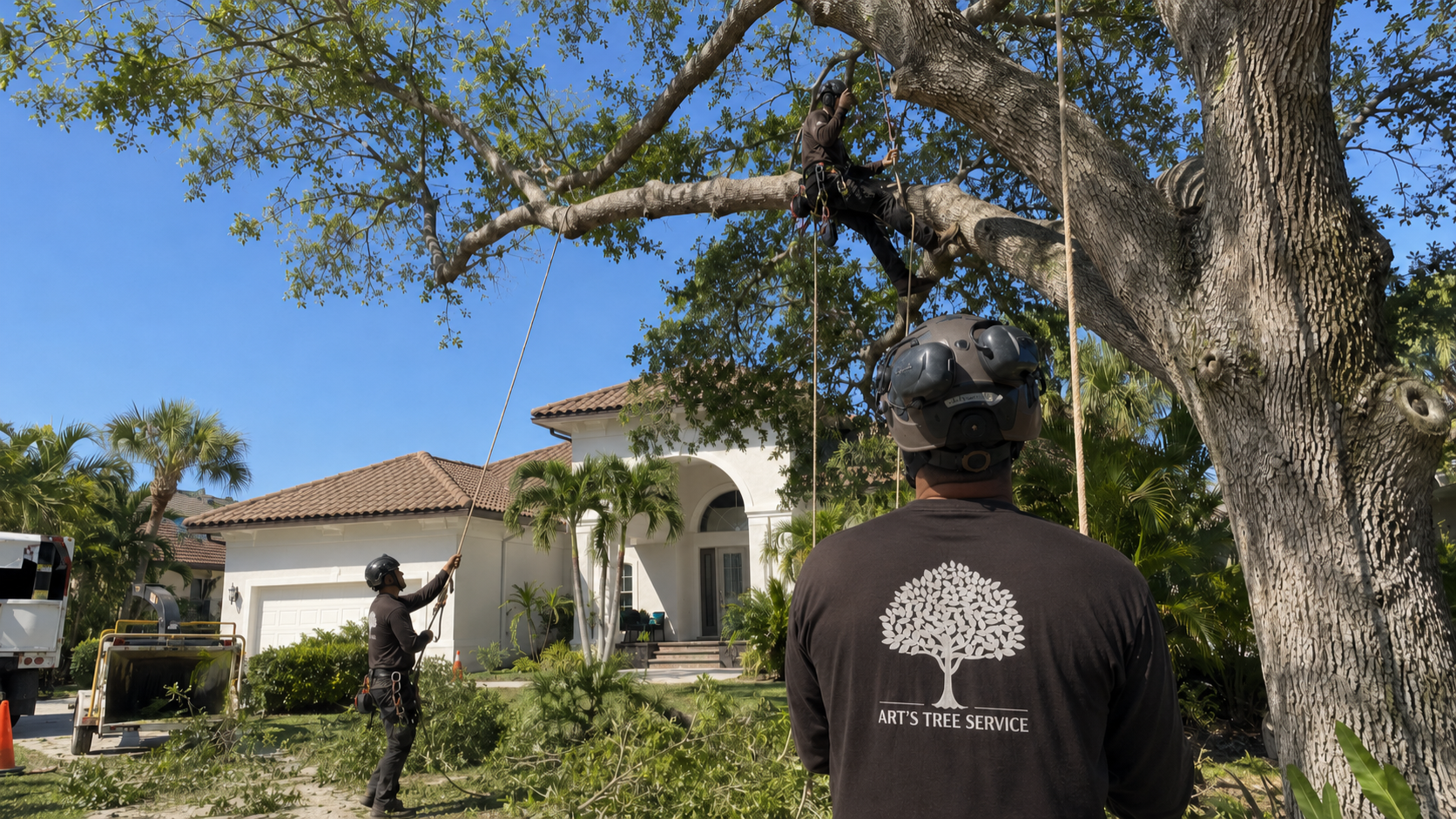
The best time to prune trees in Sarasota depends on the tree species, its age and health, and why the work is needed. Dead, broken or hazardous branches should be addressed when they create a risk. Planned structural pruning is usually easier to schedule before hurricane season, while flowering trees may be pruned after bloom when preserving flowers is important.
There is no single month that is best for every Florida tree. A mature live oak, a young shade tree, a fruit tree and a palm require different decisions. Good pruning starts with an objective, not a calendar.
Key Takeaways
- Hazardous and broken branches should not wait for a preferred season.
- Plan routine risk-reduction work early, before hurricane-season demand.
- The best timing depends on species, health, age and pruning objective.
- Avoid topping, lion's-tailing, flush cuts and excessive foliage removal.
- Palms should not receive severe "hurricane cuts."
- For species-appropriate service, visit our tree trimming and pruning page.
Direct answer: For many Sarasota properties, the practical time to inspect trees and complete planned pruning is during the drier months and early spring, before hurricane threats become imminent. However, safety work can be necessary at any time, and flowering, fruiting, young, mature and storm-damaged trees may need different timing.
Why Does the Best Time to Prune Trees in Sarasota Matter?
Pruning removes living tissue and changes how wind, weight and sunlight move through a canopy. The tree must use stored energy to respond to the cuts. Timing matters because growth stage, weather, pests, flowering and existing stress can affect recovery.
The season is only one part of the decision. A well-timed job can still harm a tree if it removes too much foliage or uses poor cuts. A properly executed safety correction may be necessary even when the timing is not otherwise ideal.
Before pruning, define the goal:
- Remove dead, broken or hanging branches
- Improve the structure of a young tree
- Shorten an overextended limb
- Provide clearance from a roof, driveway or walkway
- Reduce a specific failure risk
- Restore a tree after storm damage
- Manage a branch growing toward a structure
If the goal is simply to "thin everything out," pause. Removing interior foliage without a specific structural purpose can create lion's-tailing, shift weight toward branch ends and increase stress.
When Should Sarasota Trees Be Pruned Before Hurricane Season?
Routine inspections and planned pruning should be completed before a tropical system is approaching. Early scheduling gives the tree service time to evaluate the structure, define the work and avoid rushed cuts.
Proper pruning can reduce particular risks, such as a dead branch over a pool cage or an overextended limb with a weak attachment. It cannot make a tree hurricane-proof.
Do not ask for the canopy to be stripped so wind can "pass through." UF/IFAS warns against over-thinning mature trees. Interior branches contribute to structure and energy production, and removing too much live foliage can increase stress.
For properties with large trees near homes or screened enclosures, combine pruning with a broader tree health care evaluation. Root problems, decay or a weak union cannot always be solved by removing branches.
Can Dead or Dangerous Branches Be Pruned at Any Time?
Yes, safety takes priority over a preferred season. A broken limb over a driveway, a hanging branch after a storm or deadwood above an occupied area should be evaluated promptly.
If the tree is touching a power line, do not approach it. Contact the utility company and use a qualified line-clearance professional.
After severe weather, the immediate goal is hazard reduction and canopy cleaning. UF/IFAS advises preserving as much healthy live wood as practical so the tree has energy to recover. Major reshaping can be postponed.
For urgent situations, call (941) 877-1317 or use our emergency tree removal service.
When Should Flowering Trees Be Pruned?
If flowers are the priority, many flowering trees are pruned after their main bloom. Pruning before flowering may remove buds and reduce the display.
That general rule does not override safety or species-specific care. A damaged branch should not remain over a walkway merely to preserve flowers. Some flowering trees also bloom on new growth, while others form buds on older wood.
Before pruning a valued flowering tree, identify the species and decide whether the objective is appearance, clearance, structure or risk reduction.
When Should Young Trees Be Structurally Pruned?
Young trees benefit from early structural pruning that encourages a strong trunk and well-spaced permanent branches. Small cuts made at the right time can prevent larger wounds later.
A young-tree plan may:
- Select or reinforce a dominant leader when appropriate for the species
- Reduce competing stems
- Improve spacing between permanent branches
- Correct branches growing into one another
- Keep low temporary branches long enough to support trunk development
Structural pruning is not the same as raising the entire canopy immediately. Removing too many low branches from a young tree can slow trunk development and create poor proportions.
Our tree planting and installation service can include guidance on mature size, placement and early care so pruning needs are considered from the beginning.
How Should Mature Trees Be Pruned?
Mature trees generally tolerate large wounds and heavy foliage removal less well than young trees. Pruning should focus on a clear objective and preserve healthy interior growth.
UF/IFAS recommends managing risk by addressing dead branches, clearance needs and specific defects. Shortening an overextended limb with an appropriate reduction cut may reduce load and movement more effectively than stripping small branches from the interior.
Mature trees should be assessed in the context of nearby targets. The same defect carries different consequences over an unused corner of a large lot than over a bedroom, pool cage or busy driveway.
Pro Tip: Ask the estimator to state the pruning objective in writing. "Reduce the end weight on the west limb over the pool cage" is measurable. "Thin the tree" is too vague.
When and How Should Palms Be Pruned?
Palms are not pruned like branching hardwood trees. Remove dead or hazardous fronds and flower or fruit stalks when needed, but retain healthy green fronds. Our guide to palm trimming mistakes and hurricane cuts explains why aggressive pruning can harm Sarasota palms.
A severe "hurricane cut" removes functioning foliage and can expose the growing point. UF/IFAS notes that overpruned palms suffered more hurricane damage than palms that were not overpruned.
Yellowing or partially green fronds may still be providing nutrients. Their condition can also signal a nutrition or health issue that pruning alone will not solve.
What Pruning Mistakes Should Sarasota Homeowners Avoid?
Topping
Topping cuts major branches back to stubs. It creates large wounds and weakly attached sprouts and can accelerate decline.
Lion's-tailing
Removing most interior branches while leaving foliage only at the ends shifts weight outward and does not create a strong storm-resistant structure.
Flush cuts
Cutting into the trunk or removing the branch collar can enlarge the wound and interfere with the tree's natural response.
Leaving long stubs
Stubs do not close properly and can become entry points for decay.
Removing too much live foliage
The amount a tree can tolerate varies. Mature, stressed and storm-damaged trees often require a conservative approach.
Using climbing spikes on a tree being retained
Spikes wound the trunk and should not be used to climb a tree that will remain, except in specific emergency rescue situations.
Pruning without considering utilities
Work near energized lines requires specialized qualifications. Homeowners should never attempt it.
How Do You Know a Tree Needs Pruning Now?
Request an assessment when you notice:
- Dead or hanging branches
- Cracked or split unions
- Branches rubbing or crossing
- An overextended limb above a structure
- Low branches blocking safe access or visibility
- Storm damage
- A newly developing competing stem on a young tree
- Broken palm fronds that could fall
Pruning may not be the correct response to every symptom. A thinning canopy, mushrooms at the base, root damage or a new lean may require health or risk assessment instead.
Frequently Asked Questions
Is winter the best time to trim every tree in Florida?
No. Winter can be convenient for inspecting and pruning some trees, but Florida species and pruning objectives vary. Safety, flowering, growth habit, health and storm damage can change the recommendation.
Should I trim my trees right before a hurricane?
Do not wait until a storm is approaching. Rushed, heavy pruning can create damage and may not address the real risk. Schedule preventive inspections and planned work early.
How often should mature trees be pruned?
There is no universal interval. Prune mature trees for a defined purpose based on inspection, species, condition and location. Some trees need periodic attention, while others may require only monitoring.
Can pruning save a leaning tree?
Sometimes pruning can reduce load, but a new lean with disturbed soil may indicate root failure. That condition requires prompt assessment and cannot be solved safely by guessing how much canopy to remove.
Is tree trimming the same as tree pruning?
The terms are often used interchangeably, but professional pruning describes cuts made for a specific objective, such as structure, clearance, health, restoration or risk reduction.