
Key Takeaways
- Not every storm-damaged tree needs to be removed immediately. Some can be saved with professional pruning and monitoring.
- Certain warning signs (uprooting, trunk splits, hanging limbs over occupied areas) require urgent professional evaluation.
- Topping, lion's-tailing and removing live foliage immediately after a storm can cause more harm than the storm itself.
- Palms require different post-storm treatment than hardwood trees.
- Document the damage with photographs before any work begins.
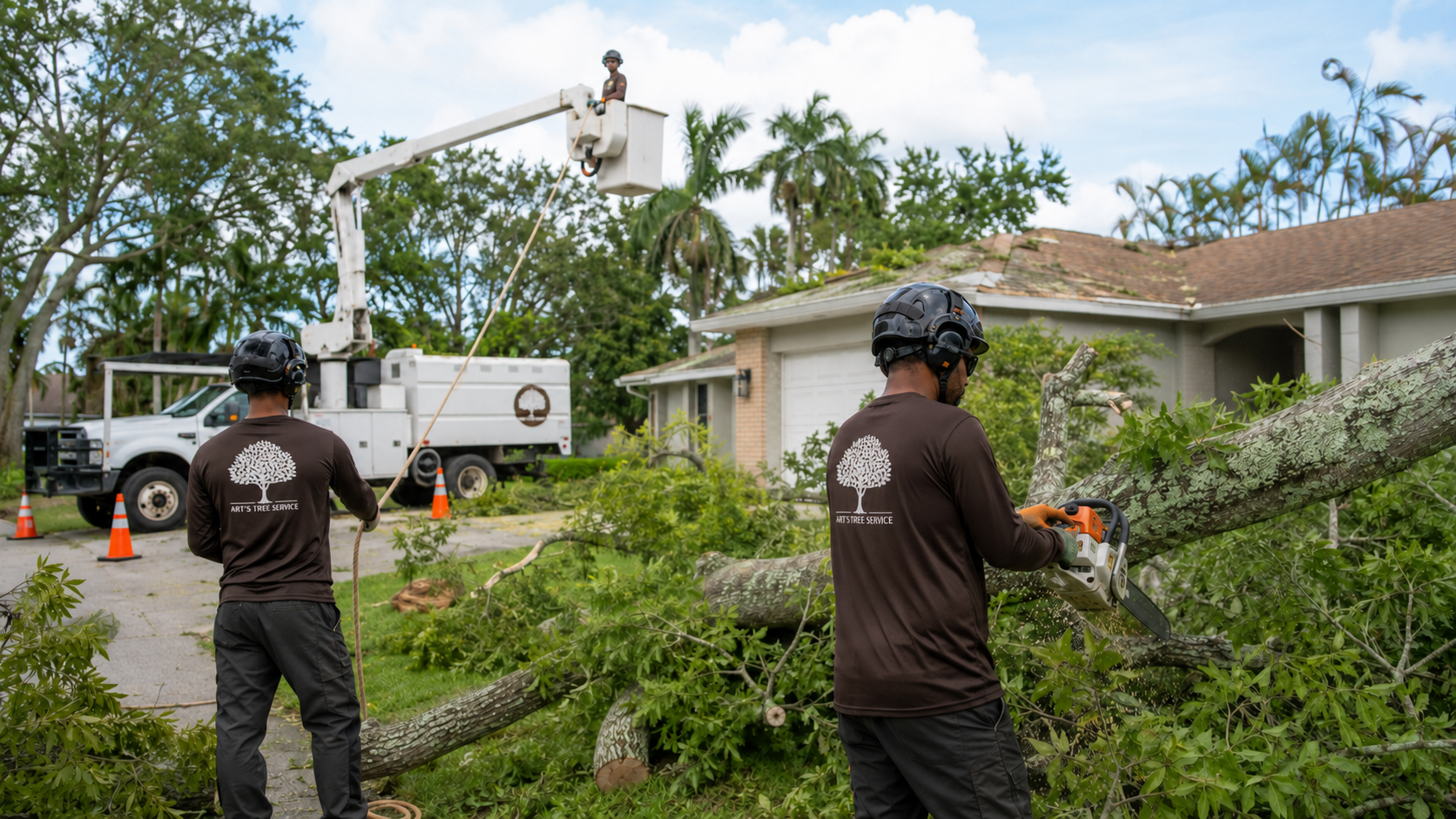
Sarasota and the surrounding Gulf Coast communities experience tropical storms, named hurricanes and fast-moving afternoon squalls that can leave trees broken, leaning or partially uprooted. The decisions made in the hours and days after a storm affect whether a tree recovers, whether it becomes a long-term hazard and whether insurance documentation is preserved.
This guide covers what to look for, which situations require immediate professional help and what not to do while waiting for an assessment.
What Are the Most Urgent Signs After a Storm?
Some damage requires prompt professional evaluation. Contact a tree service as soon as it is safe to do so when you observe any of the following:
- A tree or large branch is resting on a structure, power line or fence
- The trunk has split at a major fork or along its length
- The root ball has lifted or the tree has a new lean it did not have before the storm
- Large hanging or partially attached limbs are suspended over a driveway, pool cage, walkway or occupied area
- The tree has fallen and is blocking access or creating a safety hazard
- Bark has been stripped from a significant portion of the trunk
If a tree or branch is in contact with a power line, do not approach it. Contact your utility provider first. Emergency tree removal is appropriate when the hazard cannot wait for a scheduled appointment.
Can a Storm-Damaged Tree Be Saved?
Many storm-damaged trees can recover with proper care. Whether a specific tree is worth saving depends on several factors that a professional assessment should evaluate:
- Species and age: Some species compartmentalize wounds well and recover reliably. Others are more prone to decay after major damage.
- Extent of the damage: A tree that has lost less than half of its canopy and has an intact root system and trunk has a better prognosis than one that is split or uprooted.
- Existing health: A tree with prior decay, root problems or structural defects before the storm may not be a good candidate for restoration.
- Location and targets: A tree near a home, pool cage or driveway requires a more conservative risk assessment than one in an open area.
- Root system: A tree with a partially lifted root ball may or may not be resettable depending on species, root condition and soil.
Canopy loss is only one part of the decision. Restoration potential also depends on the species, size of broken branches, trunk and root integrity, previous health, structure and nearby targets. A single percentage should not determine whether a tree is saved or removed. A qualified professional should evaluate the full picture before a recommendation is made.
What Should You Do While Waiting for a Professional?
If the tree is not an immediate hazard, there are steps you can take before the arborist arrives:
- Document the damage: Photograph the entire tree, the base of the trunk, the damaged area and any nearby structures. These images support insurance claims and help the estimator prepare.
- Keep the area clear: Do not park vehicles, store equipment or allow people to work under a damaged tree until it has been evaluated.
- Leave debris in place when safe: Moving large branches can shift loads and create new hazards. Small debris already on the ground is generally safe to clear.
- Note what changed: A new lean, a crack that was not there before or soil movement around the base are all relevant observations for the assessment.
What Should You Avoid After Storm Damage?
Do not top the tree
Topping (cutting the main trunk or major branches to stubs) does not make a storm-damaged tree safer. It creates large wounds that are slow to close, introduces decay and produces weakly attached regrowth. UF/IFAS specifically advises against topping storm-damaged trees.
Do not remove excessive live foliage
Immediately after a storm, the priority is removing hazards and cleaning broken branches. Major reshaping can wait. Removing too much live wood reduces the tree's ability to recover.
Do not apply wound paint as a routine fix
Proper pruning cuts and ongoing monitoring are more important than coating a wound. A professional can determine whether a special treatment is appropriate for a specific condition.
Pro Tip: If the tree is safe enough to photograph, include the entire tree, the base of the trunk, the damaged area and nearby structures. Those four views give the estimator better context than a close-up alone.
How Are Storm-Damaged Trees Restored?
Restoration begins with risk reduction. Broken, cracked and hanging branches are removed with appropriate cuts while preserving as much viable canopy as practical. The tree is then monitored for recovery.
Later visits may manage new sprouts and rebuild branch structure. Large or severely damaged mature trees may need a multiyear plan. Young trees can sometimes recover faster, while older trees with decay or poor root systems may be poor candidates.
Palms require different treatment from hardwood trees. Green or partially green fronds often continue supplying energy to the palm and should not be removed simply to make the canopy look symmetrical. Overpruning, including the severe hurricane cut, can reduce palm health and expose the growing point.
Our tree trimming and pruning service is designed around the tree's condition and the specific objective, whether that is hazard reduction, canopy cleaning or long-term structural improvement.
How Can Sarasota Homeowners Reduce Future Storm Damage?
No tree is storm-proof, but good planning can reduce avoidable risk.
- Schedule periodic inspections, especially for large trees near homes, pool cages and driveways.
- Correct structural problems while trees and branches are still young.
- Remove dead, cracked or poorly attached branches before hurricane season.
- Avoid topping, lion's-tailing and excessive palm pruning.
- Protect roots from trenching, grade changes, soil compaction and vehicle traffic.
- Choose a tree that fits the site's mature space, drainage, wind exposure and proximity to utilities.
- Plant far enough from structures and overhead lines.
- Monitor changes after construction, flooding or major storms.
Homeowners in Sarasota and surrounding communities can also review our Sarasota tree service area and recent local projects.
Frequently Asked Questions
Should I remove a tree immediately after a hurricane?
Not unless it presents an urgent, unacceptable risk. Some trees can recover, and the best treatment may involve hazard pruning followed by monitoring. A professional assessment should consider the trunk, roots, major branches, species, health and nearby targets.
Can a leaning tree straighten itself after a storm?
A newly leaning mature tree with disturbed soil or lifted roots may be unstable and should be evaluated promptly. Small or recently planted trees may sometimes be reset and staked, but this should be done correctly to avoid additional root or trunk damage.
Will homeowners insurance pay for storm-damaged tree removal?
Coverage varies by policy and circumstances. Contact your insurer, document the damage and ask what records or estimates are required. Art's Tree Service cannot interpret insurance coverage.
Is it safe to cut a broken branch myself?
Only small debris already on the ground may be reasonable for a homeowner to move when there are no electrical, overhead or structural hazards. Large branches, suspended limbs, chainsaw work and any work above ground should be left to trained professionals.
How soon should storm-damaged trees be inspected?
As soon as it is safe, especially when a tree is leaning, split, uprooted, blocking access or threatening a structure. Less urgent damage should still be evaluated before another storm increases the load.